Differences Between Saving and Investing: Which Should You Do?
Learn the key differences between saving and investing, when to do each, and how to balance both for your financial goals. Real examples included.
My friend Sarah called me last month in a panic. She'd finally saved up $10,000 and had no idea what to do with it. "Should I just keep it in my savings account? Or is that stupid? Everyone keeps telling me to invest, but I don't want to lose it."
She's not alone. Understanding the differences between saving and investing trips up a lot of people — even those who are otherwise pretty good with money. And honestly, the confusion makes sense. Both involve setting money aside for the future. Both require discipline. But they serve completely different purposes, and mixing them up can cost you thousands over time.
Let me break this down the way I wish someone had explained it to me ten years ago.
What Saving Actually Means (And What It's Good For)
Saving is putting money somewhere safe where you can access it quickly. That's it. We're talking savings accounts, money market accounts, CDs, or even that envelope of cash you hide in your sock drawer (though I don't recommend that last one).
The defining features of saving: - Low risk — your principal is protected (and often FDIC insured up to $250,000) - High liquidity — you can get your money within hours or days - Low returns — currently around 4-5% APY for high-yield savings accounts
Saving works best for: - Emergency funds (3-6 months of expenses) - Short-term goals (vacation next year, new laptop in six months) - Money you absolutely cannot afford to lose - Cash you might need within the next 1-3 years
Here's something that took me way too long to understand: saving isn't about growing wealth. It's about preserving it and keeping it accessible. If you're saving for a house down payment you need in 18 months, a savings account is exactly where that money belongs — even if your brother-in-law insists you're "leaving money on the table."
What Investing Actually Means (And Why It Matters)
Investing is putting money into assets that have the potential to grow over time. Stocks, bonds, real estate, index funds, ETFs — these are all investments. Unlike savings, your principal isn't guaranteed. You could lose money. But historically, you're also likely to make significantly more.
The defining features of investing: - Higher risk — values fluctuate, sometimes dramatically - Lower liquidity — selling takes time, and you might sell at a loss - Higher potential returns — the S&P 500 has averaged about 10% annually over the long term
Investing works best for: - Retirement (money you won't touch for 10+ years) - Long-term wealth building - Goals that are 5+ years away - Money you can afford to see drop 20-30% temporarily
That last point is crucial. In 2022, the S&P 500 dropped about 18%. If you'd invested $10,000 at the start of that year, you'd have seen it shrink to around $8,200. Painful? Absolutely. But if you didn't need that money and left it alone, you'd have recovered and then some by mid-2024.
Should I Save or Invest My Money?
This is the question I get asked most often, and the answer is frustratingly simple: it depends on when you need the money.
Need it within 1-3 years? Save it. Put it in a high-yield savings account and don't overthink it. Yes, you might "only" earn 4-5% while the stock market returns 10%. But you also won't wake up one morning to find your down payment fund has shrunk by 15% because tech stocks had a bad week.
Won't need it for 5+ years? Invest it. The longer your time horizon, the more you can ride out market volatility. Historically, the stock market has never had a negative return over any 20-year period. Not once.
3-5 years? This is the gray zone. Personally, I lean toward a mix — maybe 60% in savings and 40% in a conservative investment like a bond fund or balanced fund. But I'm also someone who checks my accounts too often and would stress about a big drop. If you're more relaxed about it, you might lean heavier into investments.
Here's a real example from my own life. I have three buckets of money:
- Emergency fund — 4 months of expenses in a high-yield savings account earning 4.5%. I don't touch this unless something genuinely unexpected happens.
- House renovation fund — We're planning to redo our kitchen in about 2 years. This sits in a CD ladder (some maturing every 6 months) earning around 4.8%. Not exciting, but it'll be there when we need it.
- Retirement accounts — 401(k) and Roth IRA invested in low-cost index funds. I don't plan to touch this for 25+ years, so I'm 90% stocks. When the market dropped in 2022, I actually increased my contributions because everything was "on sale."
The key is matching your timeline to your strategy. Most financial mistakes happen when people invest money they need soon (and panic-sell during a downturn) or save money they won't need for decades (and lose purchasing power to inflation).
The Hidden Cost of Only Saving
Let me show you some numbers that changed how I think about this.
Say you're 30 years old and you put $10,000 into a savings account earning 4% annually. In 30 years, when you're 60, you'd have about $32,400. Not bad, right?
Now say you invested that same $10,000 in an index fund averaging 8% annually (a conservative estimate, below the historical 10% average). In 30 years, you'd have about $100,600.
That's a difference of $68,200 — on just a single $10,000 deposit.
And here's the part that really stings: inflation averages about 3% per year. Your $32,400 in savings would have the purchasing power of roughly $13,300 in today's dollars. You'd have barely beaten inflation. Your invested money, even accounting for inflation, would be worth around $41,400 in today's purchasing power.
This is why financial advisors get so worked up about investing for retirement. Saving feels safe, but over long periods, it's actually the riskier choice because you're almost guaranteed to lose purchasing power.
How to Balance Saving and Investing
Most people shouldn't choose one or the other — they should do both. Here's a framework that's worked well for me and the people I've helped:
Step 1: Build a Starter Emergency Fund
Before you invest a single dollar, get at least $1,000-2,000 in a savings account for true emergencies. Car breaks down. Unexpected medical bill. Stuff happens.
Step 2: Capture Any Employer Match
If your employer offers a 401(k) match, contribute enough to get the full match. This is literally free money — a 50-100% instant return. Don't leave it on the table.
Step 3: Build a Full Emergency Fund
Work toward 3-6 months of flexible expenses and fixed costs in savings. If your job is unstable or you're self-employed, lean toward 6 months. If you have a stable job and a working spouse, 3 months might be fine.
Step 4: Max Out Tax-Advantaged Investing
Once your emergency fund is solid, prioritize retirement accounts. In 2024, you can contribute up to $23,000 to a 401(k) and $7,000 to an IRA. The tax benefits alone make these accounts worth maxing out if you can swing it.
Step 5: Save for Short-Term Goals
Got a wedding to pay for next year? Saving for a vacation? These go in savings accounts or CDs. Don't invest money you'll need soon.
Step 6: Invest Additional Money
Anything beyond the above? Open a taxable brokerage account and invest in low-cost index funds. This is money that can grow for years without the contribution limits of retirement accounts.
Tracking all these different buckets can get messy. I used to lose track of which savings account was for what goal. If you want something that handles this automatically, KlutterAI can categorize your accounts and show you exactly how each bucket is performing toward your goals.
Common Mistakes People Make
I've seen these errors so many times:
Keeping too much in savings "just in case." I know someone with $80,000 in a savings account earning 0.01% because she's "nervous about the market." She's been nervous for 12 years. Meanwhile, that money has lost roughly 30% of its purchasing power to inflation.
Investing the emergency fund. Your emergency fund needs to be boring. It's insurance, not an investment. When you lose your job, you don't want to be forced to sell stocks at a loss to pay rent.
Trying to time the market. "I'll invest once things calm down" is a losing strategy. Things never feel calm. There's always a crisis, an election, a pandemic, something. The best time to invest was yesterday. The second best time is today.
Ignoring fees. A 1% annual fee on your investments might not sound like much, but over 30 years, it can eat up 25% of your returns. Stick with low-cost index funds charging 0.03-0.20%.
Not adjusting as goals approach. If you're 5 years from retirement, you should be shifting from aggressive investments to more conservative ones. Don't get greedy and stay 90% in stocks when you need the money soon.
What About Paying Off Debt?
I'd be doing you a disservice if I didn't mention this. If you have high-interest debt (credit cards, personal loans above 8%), paying that off beats both saving AND investing in most cases.
Think about it: paying off a credit card charging 22% interest is like getting a guaranteed 22% return on your money. No investment can promise that.
My priority order: 1. Minimum payments on all debts (to avoid penalties) 2. Starter emergency fund ($1,000-2,000) 3. Employer 401(k) match 4. Pay off high-interest debt aggressively 5. Full emergency fund 6. Max retirement accounts 7. Save for short-term goals 8. Invest additional money
This isn't the only valid approach, but it's worked for me and accounts for both the math and the psychology of money.
A Note on Risk Tolerance
Everything I've said assumes you can emotionally handle market volatility. Some people can't, and that's okay.
If watching your portfolio drop 20% would cause you to panic-sell, you might be better off with a more conservative investment mix — even if it means lower long-term returns. The best investment strategy is one you can actually stick with.
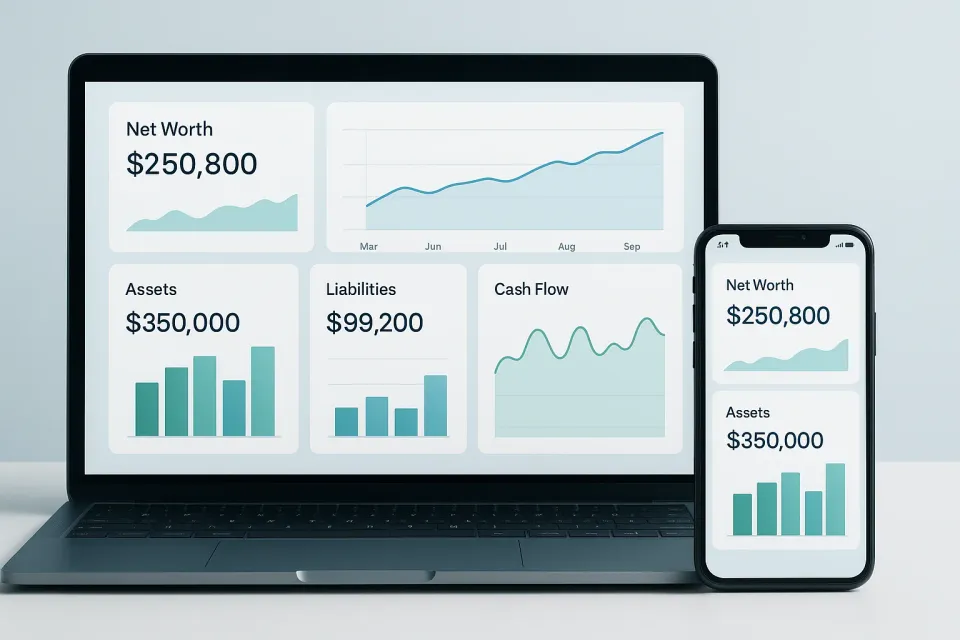
I've found that tracking your net worth regularly (not daily, but monthly) helps you stay calm during downturns. When you can see that your overall financial picture is still healthy, a temporary investment drop feels less catastrophic. There are solid net worth tracking apps that make this easy to visualize.
Frequently Asked Questions
Is it better to save or invest right now?
It depends on your timeline. For money you need within 3 years, save it in a high-yield savings account. For money you won't touch for 5+ years, invest it. With current high-yield savings rates around 4-5%, short-term saving is more attractive than it's been in years, but it still can't match long-term investment returns.
How much should I have in savings before investing?
Most financial experts recommend having 3-6 months of expenses in an emergency fund before investing beyond your employer's 401(k) match. For someone spending $4,000/month, that's $12,000-24,000 in savings. Once you hit that threshold, additional money can go toward investments.
Can I lose money in a savings account?
You won't lose your principal in an FDIC-insured savings account (up to $250,000). However, you can lose purchasing power if your interest rate is lower than inflation. If inflation is 3% and your savings earns 1%, you're effectively losing 2% per year in real terms.
What's the safest way to start investing?
The safest entry point for beginners is a low-cost, diversified index fund like a total stock market fund or target-date retirement fund. These spread your risk across hundreds or thousands of companies. Start with whatever you can afford — even $50/month — and increase contributions over time.
Should I invest if I have student loans?
It depends on the interest rate. If your student loans are below 5-6%, you might benefit from investing while making minimum payments, since investments historically return more. If your loans are above 7%, prioritize paying them down. Always contribute enough to get any employer 401(k) match first — that's free money regardless of your loan rate.
The Bottom Line
The differences between saving and investing come down to safety versus growth, and short-term versus long-term. Neither is inherently better — they serve different purposes.
Save money you'll need soon. Invest money you won't touch for years. And do both.
Sarah, my friend from the beginning of this article? She ended up putting $5,000 in a high-yield savings account as an emergency fund and invested the other $5,000 in a target-date retirement fund. Six months later, she told me it was the first time she'd ever felt like she had a real financial plan.
That's the goal. Not perfection, just a plan that makes sense for your life.